An HGV MOT check means looking up the test record of a heavy goods vehicle or trailer, but heavy vehicles are not tested in quite the same way as cars. In Great Britain lorries and trailers over the weight threshold take an annual test run by the DVSA, and the public record is separate from the standard car record. The free tools for cars and light vans are still useful, but they do not cover every heavy vehicle.
Part of MOT Status & Expiry. Start with the main guide: MOT Check: Status, Expiry and Test Results
Updated October 2026 · Independent information, not legal advice
People search for an HGV MOT check when they are buying a lorry, hiring a haulier, inspecting a fleet or simply curious about a vehicle they have seen. Knowing what the record can show, what it cannot and where the official source sits saves time. For ordinary cars and vans, you can check your MOT status and expiry date for free.
What An HGV MOT Check Actually Covers
A sensible check has three parts: identifying the vehicle correctly, reading the result and dates, and then asking what the record does not show. Skipping the first step is the most common reason people think a record is missing. If you are comparing a lorry with a car, bear in mind that a used car lookup and a heavy vehicle enquiry answer different questions.
An HGV MOT check is shorthand for finding out whether a heavy vehicle has a current annual test and what happened at earlier tests. It is a question about roadworthiness, not about ownership or finance.
The everyday meaning
Most people use "MOT" for any vehicle test. For heavy goods vehicles the official term is the annual test, but the idea is the same: an inspection at an authorised centre with a recorded result.
What it cannot tell you
It cannot confirm the operator licence, insurance, who owns the vehicle or whether finance is outstanding. Those come from other sources.
Annual Test Or MOT: The Terminology
Cars and light vans take an MOT test. Heavy goods vehicles, buses and many trailers take an annual test under a related but separate system. The standards, forms and test stations differ, even though the purpose is similar.
- Cars and light vans: MOT under the standard classes
- Heavy goods vehicles: annual test at DVSA approved facilities
- Trailers above the weight threshold: annual test, usually linked to a plating certificate
Why people still say MOT
The phrase is shorthand that people understand. Searching for "hgv mot history" therefore finds the same topics as an annual test search.
Which Vehicles Count As HGVs
A heavy goods vehicle is generally a goods vehicle with a gross weight above 3.5 tonnes. Gross vehicle weight is the maximum the maker says the vehicle can weigh when loaded, and it is on the plate.
Rigid lorries and articulated units
Both rigid lorries and tractor units fall within the category, as do vehicles with drawbar trailers.
Why weight matters
A van at or below the threshold is tested as a light vehicle under the usual MOT classes. See what MOT class your vehicle is if you are unsure which side of the line a vehicle falls.
| Vehicle type | Usual test name | Where to look |
|---|---|---|
| Car or light van | MOT | The free MOT history lookup |
| Lorry (HGV) | Annual test | Official heavy vehicle sources |
| Trailer | Annual test | Official sources, using trailer ID |
| Bus or coach | Annual test | Official sources, check GOV.UK |
Trailers And Their Tests
Trailers are easy to overlook because they have no engine and often sit for weeks between jobs. Yet axles, hubs, brake chambers, landing legs and lighting all wear, and a neglected trailer can fail for several reasons at once. Anyone coupling to a trailer they do not own should ask when it was last tested and look at the plate and identification for themselves.
Many heavy trailers need an annual test, and trailer tests are tied to a plating certificate that records the permitted weights and axle loads. Light trailers below the threshold are generally not subject to an annual test.
- Heavy goods trailers are tested annually
- Plating records the maximum permitted weights
- Very light trailers are usually not MOT tested
Trailer identification
Trailers usually have a trailer ID or chassis number rather than a registration plate that matches a tractor unit. Checking the identification on the plate is essential.
Buses, Coaches And Other Heavy Vehicles
Passenger carrying vehicles, such as buses and coaches, follow their own test regime. This topic focuses on goods vehicles and trailers, but the same principle applies: there is an annual inspection and a recorded result.
Check the official source
Vehicle categories can be complicated, for example for special purpose vehicles or converted vans. GOV.UK sets out which test applies.
Why Check The Test History Of A Lorry Or Trailer
Heavy vehicles do high mileage in hard conditions, so wear items such as brakes, tyres, suspension bushes and air systems matter a great deal. A buyer who reads the history can see whether the same items keep appearing. A seller who has already acted on earlier advisories has a stronger story to tell.
A test record gives an independent view of how a heavy vehicle has been maintained. For a large purchase, hire or contract, it is one piece of evidence you can gather quickly.
- Spot repeated fail results for the same component
- Notice recurring advisory items such as brakes or corrosion
- Confirm the vehicle has been tested regularly
- Compare recorded mileage or hours with what you are told
A record is not an inspection
Test history does not replace a hands-on inspection by a qualified engineer. It helps you ask better questions.
Who Needs An HGV MOT History Check
The check is useful to several people.
- Buyers of second hand lorries and trailers
- Owner drivers and small hauliers
- Fleet managers and transport managers
- Companies hiring hauliers or subcontractors
- Insurers, leasing firms and auditors
Buyers
A buyer can compare the advertised condition with the record. A sudden run of fails that stops may suggest repairs, or a gap in testing.
Transport managers
A manager can confirm that all vehicles in the fleet show valid test dates and no pattern of repeated defects.
What The Free Checker Shows For Cars And Light Vans
For cars and light vans the free MOT history checker shows make, model, colour, fuel, MOT expiry date, each past test with pass or fail, advisories, major and dangerous defects, and recorded mileage.
Useful for light commercial vehicles
A panel van at or below the weight threshold is a good example. The standard lookup applies to it.
Not designed for every heavy vehicle
A large lorry or trailer may sit outside the standard record, so a missing result is not proof that a test has been skipped.
| Feature | Free car and light van checker | Official heavy vehicle route |
|---|---|---|
| Best for | Cars and light vans | Lorries, trailers and larger vehicles |
| Identifier | Registration | Registration or trailer ID |
| Coverage | May not include heavy vehicles | Designed for these records |
Checking A Vehicle MOT History Step By Step
If you want to check vehicle MOT history for a van, car or light vehicle, the route is simple.
- Have the registration number ready
- Enter it into the free MOT history checker
- Read the test dates, results and advisories
- Compare recorded mileage between tests
- Note any gaps or repeated failures
If you need the heavy vehicle record
For vehicles above the weight threshold, use the official DVSA route on GOV.UK. The service you need may have a different name from the car lookup, so search for the annual test history service.
Finding HGV MOT History Through Official Sources
To check HGV MOT history, the authoritative place is GOV.UK, where DVSA publishes the tools it supports. The service for heavy vehicles and trailers can change in name and format, so always begin from GOV.UK rather than a third party.
- Start at GOV.UK and search for the heavy vehicle annual test history
- Enter the registration or trailer ID as requested
- Read the result carefully, including advisories and defect categories
Caution about third party sites
Some commercial sites charge for information that is free from the official source. You are not obliged to pay for the statutory test record.
Lorry MOT Checker And Trailer MOT Checker Searches
Search phrases like lorry MOT checker or trailer MOT checker reflect what people want rather than the official name of a service. They are looking for a simple lookup, ideally free.
What to expect from such a tool
A genuine tool uses DVSA data. If it asks for payment for basic test results, pause and check GOV.UK.
What the official route shows
Usually the test date, result and notes about defects. The exact fields depend on the service.
The YouGov MOT Check Mix-Up
Some people type "yougov mot check" when they mean the GOV.UK service. YouGov is an unrelated polling company and has nothing to do with the test record. The correct place to begin is GOV.UK.
Why this happens
"Gov" and "you" sound similar when spoken, and search engines often correct the spelling anyway.
Stay on official addresses
Look for the gov.uk domain when you enter a registration or personal details.
Registration, Trailer ID And VIN
Heavy vehicles are identified by more than a number plate. A lorry has a registration, a chassis or VIN and a plating plate. A trailer may have only an ID and chassis number.
- Registration number: shown on the plates
- VIN or chassis number: stamped on the frame and listed on documents
- Trailer ID: often on a plate or sticker
Why it matters
Searching with the wrong identifier returns no result or the wrong vehicle. Learn more in what a VIN number is.
Reading An Annual Test Result
Read a record from the oldest entry to the newest. Early results show how the vehicle was looked after when it was younger, and later ones show the pattern of recent maintenance. A single fail is rarely alarming, but a run of fails followed by a long gap invites questions. Also read the notes, because the free text often explains what a category label alone cannot.
A result shows whether the vehicle passed, failed or was refused. It also shows the test date and any items the examiner wished to record.
Result categories
Expect pass, fail and possibly prohibition related notes. The language on a record may differ slightly from a car record.
Dates
The date of the test and any expiry or next due information helps you plan. Heavy vehicle tests often follow a different pattern from the car schedule.
What An MOT Pass Means For A Heavy Vehicle
An MOT pass on a heavy vehicle means it met the required standard on the day. It does not mean it will remain roadworthy, nor that the load, tyres or brakes are in perfect condition a week later.
A passing record is a baseline
Good operators still carry out regular checks between tests.
Pass with advisories
Advisories show items examiners consider worth watching. Read them as maintenance prompts.
Understanding MOT Advisories On Trailers And Lorries
MOT advisories are recorded observations, not failures. Typical topics include wear in brake components, corrosion, tyre condition and minor leaks.
- Advisories flag wear or early defects
- Repeated advisories can foreshadow a fail
- A clean record with no advisories is not guaranteed in practice
What to do with them
Plan repairs before the next test. For a used purchase, ask what has been done since the advisory was recorded.
Defect Categories: Minor, Major And Dangerous
Think of the three grades as a traffic light. A minor defect is worth noting, a major defect must be repaired before a pass, and a dangerous defect means the vehicle presents an immediate risk. Always read the wording of the defect itself, because two records with the same category can describe very different problems.
Defects are graded by severity. The terms are familiar from car MOTs, although the detailed rules differ by vehicle type.
- Minor defect: small fault, not a fail
- Major defect: fail, repair needed
- Dangerous defect: immediate risk, do not drive
Why the category matters to a buyer
A history full of dangerous defects that were later fixed may be fine, but it deserves questions about how thoroughly repairs were done.
Fails, Retests And Repairs On Heavy Vehicles
If a heavy vehicle fails, the operator repairs the defects and then arranges a retest. The time limits and fee rules depend on circumstances, so check GOV.UK for the current position.
Partial retests
Some faults may be rechecked without a full test if the vehicle returns within the allowed window. Do not assume this applies.
Do not drive with dangerous defects
A vehicle with a dangerous defect should not be driven, and a prohibition may be placed by enforcement officers.
Test Dates And Keeping Track Of Expiry
Do not rely on memory or on a reminder sent to a single person. Put due dates in a calendar that more than one person can see, and record the date the last test was actually completed rather than the date you think it was. If a vehicle is off the road for a long period, record when it will be back so the test is booked in good time.
Heavy vehicles rely on a recorded test date and due date. Missing a due date can stop a vehicle working, so many operators use a fleet calendar.
- Record each vehicle's due date in a shared calendar
- Set reminders well ahead of the MOT expiry date
- Keep test paperwork with the vehicle file
For light vehicles
For vans and cars, use the when is my MOT due topic to understand how due dates work.
Booking An Annual Test
Annual tests for heavy vehicles are booked through the DVSA booking service or an authorised test facility. Availability can be limited, so plan early.
Choosing a slot
Leave a buffer for repairs and a possible retest. Do not leave booking until the last week.
Documents to bring
Bring the registration or plating documents, any previous test paperwork and the keys or fifth wheel access as requested.
Test Stations And Who Carries Out The Test
Heavy vehicles are tested at DVSA sites or authorised testing facilities, where examiners and appropriate equipment are available. This is different from a typical test centre that tests cars.
Not every garage qualifies
A local garage may prepare a vehicle but cannot necessarily test it. Confirm the facility covers your vehicle category.
Vehicle access
Lorries and trailers need space, ramps and pits. Facilities are planned around that.
Preparing A Lorry Or Trailer For The Test
A dirty vehicle can hide cracks and corrosion, so cleaning is not cosmetic. Examiners may refuse to test a vehicle that is unsafe to inspect or carrying a load. Bring any documents that identify the vehicle, and make sure the plates and identification numbers are readable.
Preparation reduces the chance of a fail and the cost of a retest.
- Clean the chassis so inspectors can see the structure
- Check lights, reflectors and markers
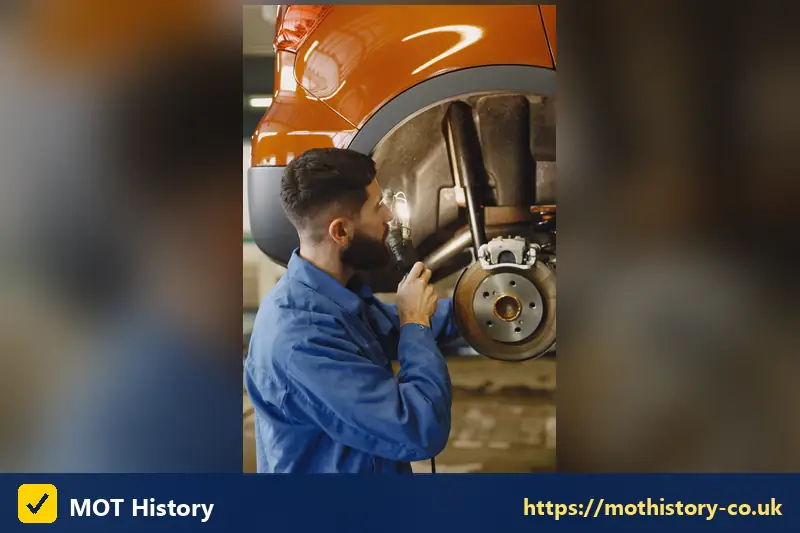
- Inspect tyres, wheel nuts and brake components
- Check air lines, couplings and suspension
- Empty the vehicle and make it safe to access
A planned service helps
A service before the test often resolves minor items. See the car service and MOT topic for a parallel with lighter vehicles.
Brakes And Braking Performance
Braking checks for heavy vehicles normally look at balance between axles, response time and overall efficiency, as well as the physical condition of drums, discs, linings and air components. Because trailers have their own braking systems, the examiner also checks that the coupling and control lines work correctly between the tractor unit and trailer. Operators who record brake adjustments and pad or lining changes usually find the annual test less stressful.
Brake condition is a central part of heavy vehicle testing. Braking efficiency is commonly measured on a rolling road or with a suitable test device, along with visual checks.
Why brakes fail
Worn linings, imbalance between axles, air leaks and poor adjustment are common causes.
Keep brake records
Maintenance records help you show the brakes have been inspected between tests.
Emissions And Smoke
The emissions test for diesel heavy vehicles focuses on visible smoke and evidence that emissions equipment is present. Tampering with systems is illegal and can lead to a fail.
Emissions equipment
Particulate filters, catalysts and related sensors should be present and working if fitted.
Warning lights
Warnings from the vehicle system should be investigated before the test.
Plating And Plates
The plating certificate and plate show the vehicle's permitted weights and axle loads. The annual test checks that the vehicle matches its plating.
- Check the plate is legible and secure
- Check that plated weights match the documents
- Raise questions if a vehicle has been modified
Why it matters to buyers
Unapproved modifications can affect legality, safety and value.
Operator Licences Are A Separate Matter
The same goes for compliance programmes that operators run internally. A vehicle can pass its annual test and still belong to a business with poor maintenance discipline. When you rely on a haulier, it is reasonable to ask about their inspection routine as well as their test results.
An operator licence authorises a business to run goods vehicles commercially above a certain weight. It is not shown on the annual test record.
Verifying licences
Operator details are published by the relevant traffic commissioner. Search GOV.UK for the current service.
Why a test record is not enough
A vehicle can have a valid test but be used by an unlicensed operator. The two are distinct.
Prohibition Notices And Roadside Checks
Enforcement officers can stop vehicles and issue prohibitions if they find serious defects or overloading. A prohibition can stop the vehicle moving until it is fixed.
- Prohibitions may be immediate or delayed
- Clearing one usually requires a repair and confirmation
- Repeat issues can affect an operator's record
Keep daily checks
Regular walkaround checks help catch defects before enforcement does. See the official guidance for requirements.
Buying A Used HGV: What To Check
Start with the paperwork, then the physical inspection. Compare the identification on the vehicle with the documents and the test record. Look for evidence of accident repair, welding on the chassis and mismatched panels. A road test with a qualified person can reveal issues that a static inspection misses. Keep in mind that no public record tells you whether the vehicle has outstanding finance, so arrange a separate finance check; the car finance checker topic explains the idea for ordinary cars.
A used lorry is a big purchase, so use multiple checks.
- Ask for the test history and compare it with the vehicle
- Check plating, chassis and identification numbers
- Request service and repair invoices
- Arrange an independent inspection
- Verify documents with the seller and the official sources
Look for gaps
A long gap between tests may mean the vehicle was off the road, exported or simply neglected.
Buying A Used Trailer
Trailers age quietly, so a documented history matters. Look for corrosion, worn hubs and brake issues.
Identification
Check the ID plate against the chassis number and paperwork. See how to get a VIN from a reg number for related identification checks on vehicles.
Ask what has been repaired
Repair work that followed a fail should have invoices.
Selling An HGV Or Trailer
A tidy file is persuasive. Put test certificates, invoices, plating paperwork and any written reports in date order so a serious buyer can follow the story quickly. If a fault is known, say so and explain what was done. Sellers who are open tend to reach a sale with fewer disputes afterwards.
A clear record helps a seller. Gather test certificates, service invoices and plating documents.
- Show recent passes and any fixes after advisories
- Be honest about known issues
- Provide identification numbers accurately
Transparency saves time
Buyers can check official records, so surprises damage trust.
Hiring Hauliers And Checking Subcontractors
If you use subcontractors, you may want some assurance they keep vehicles roadworthy. A test record is one piece of due diligence.
What to ask for
Operator licence details, recent test results and maintenance policy.
What not to assume
A vehicle with a current test can still be unsuitable for your load or route.
Drivers And Daily Walkaround Checks
Drivers are often the first to see defects. Daily checks for lights, tyres, brakes, leaks and load security help keep the vehicle compliant.
- Check lights, reflectors and indicators
- Check tyres for damage and pressure
- Look for leaks and loose parts
- Report defects promptly and in writing
Good reporting culture
Operators benefit when drivers feel able to report defects without blame.
Vans Between 3,000 And 3,500 Kilograms
Some heavier vans are tested under a different MOT class from ordinary cars. They are light enough to use the standard lookup but heavy enough to need a different class.
Class differences
See MOT classes explained for the broad structure.
Free lookup
The free MOT history checker can usually show the test record for these vans.
Cars, Car Derived Vans And The Free Car Lookup
If you need a car MOT history check free, the standard lookup gives the public record for cars and most light vans. It is also the most common way for buyers to spot problems early.
What a good check includes
Dates, results, advisories, mileage and any gaps. You can check the MOT history in seconds.
Cost of the record
The record is free at source. There is no need to pay for basic test results.
Free MOT History Versus Paid Reports
The official free MOT history record is available without payment. Some paid services combine it with other data such as finance or write-off checks, which are not part of the test record.
What paid reports can add
Outstanding finance, insurance write-off status and stolen vehicle flags are not in the MOT record.
What to ask
If you pay, ask exactly what data you are getting and where it comes from.
Horseboxes, Motorhomes And Special Vehicles
Horseboxes and motorhomes may be tested under different classes depending on weight and use. Special purpose vehicles have their own rules.
- Check the weight plate
- Check the registered use
- Check the official guidance for your category
When unsure
Ask the DVSA or check GOV.UK. A wrong class can mean a wasted test.
Northern Ireland And Heavy Vehicles
The DVSA covers Great Britain. In Northern Ireland the DVA runs vehicle testing separately, and records and booking differ. See MOT in Northern Ireland for background.
Cross-border vehicles
Vehicles moving between regions may need to follow each region's requirements. Check the official guidance.
Different systems
Do not assume a record in one system appears in the other.
Imported And Foreign Registered Vehicles
Imported heavy vehicles may have records that start late in Great Britain. A short history does not automatically mean concealed problems, but it does mean asking questions.
Checks to consider
Import paperwork, approval documents and earlier test certificates from the country of origin.
Consumer caution
See car import check for the general idea of looking at a vehicle's import status.
When The Record Looks Wrong
Errors are uncommon but possible: a missing test, a wrong mileage or a mismatched vehicle.
- Double check the registration or ID you entered
- Ask the test facility to confirm the result
- Contact DVSA through GOV.UK if it is still wrong
- Keep copies of paperwork as evidence
Missing tests
See why an MOT is not showing online for common reasons a record may not appear.
Mileage And Hours On Heavy Vehicles
Odometer readings are recorded at tests where the system captures them. A sensible buyer reads them in sequence and looks for steady growth that matches the vehicle's use. Anything odd, such as a fall between tests, should be explained in writing. Tampering with an odometer is illegal, and the record is one of the ways it can be spotted.
Odometer readings on the record help you judge use. A large drop or unexplained jump may need an explanation, such as a replaced cluster.
Compare with condition
High mileage is normal for HGVs. What matters is consistency and maintenance.
Tachograph records
Tachographs are a separate regulatory record and are not shown in the test history.
Fleet Management And Test Planning
Good fleets treat the test as the end of a cycle, not a surprise. Preventive maintenance is scheduled weeks ahead, defects from driver reports are fixed as they arise and the vehicle goes to the test facility already inspected. Many operators keep a simple scorecard showing first time pass rates by vehicle, which highlights problem units. Even a small owner driver can copy this habit with a spreadsheet and a calendar.
A fleet benefits from a routine.
- Keep a single register of vehicles and test dates
- Book tests early
- Schedule preventive maintenance before the test
- Review advisory items and fix them promptly
Use the record for audits
Reviewing your own vehicles' history can highlight recurring problems.
Common Mistakes When Checking HGV MOT History
Some errors appear again and again.
- Using a car lookup for a large lorry and assuming no result means no test
- Entering the wrong identifier for a trailer
- Relying on an advert instead of the official record
- Ignoring advisories
- Forgetting that an operator licence is separate
Double check the source
When in doubt, return to GOV.UK.
Myths About Heavy Vehicle Tests
A few myths are worth clearing up.
- Myth: A pass means the vehicle is fully safe. A pass means it met the standard on the day.
- Myth: The free car checker covers all vehicles. It does not.
- Myth: A missing record proves fraud. It may be an identification or system issue.
Keep perspective
Use the record as evidence, not as a verdict.
Summary And Practical Next Steps
For lighter vehicles, read about MOT grace period rules before assuming anything about driving with an expired test.
An HGV MOT check starts with correct identification, ends with a careful reading of the result and should be confirmed through official sources. For cars and vans, use the free checker, and for heavy vehicles and trailers, check GOV.UK for the annual test service that applies.
Quick list
- Identify the vehicle correctly
- Check the official record
- Read advisories and defects
- Inspect the vehicle if buying
Certificate and class terms
A car or light van MOT certificate is issued as a VT20 on a pass and a VT30 on a fail. Heavy vehicles are assigned a test class by weight and type, and their annual test paperwork differs, so always confirm the official format for the vehicle in front of you.
Frequently Asked Questions
Can I check an HGV MOT history for free?
Yes, in general the official test record is free at source through GOV.UK. The service for heavy vehicles and trailers may differ from the car lookup, so start from GOV.UK and search for the annual test history. Be cautious of sites that charge for basic test results, as paid reports usually combine other data.
Is there a lorry MOT checker on GOV.UK?
DVSA publishes tools for test history on GOV.UK, and the name and format of the service for heavy vehicles can change. Search GOV.UK for the heavy vehicle annual test history. Commercial pages that call themselves a lorry MOT checker may simply repackage public data, so check the source and the domain.
Is there a trailer MOT checker?
Heavy trailers take an annual test and have a trailer ID, so a trailer MOT checker needs that identifier rather than a number plate. Use the official DVSA service via GOV.UK for the test record. Light trailers below the weight threshold are generally not tested.
What is the difference between an HGV test and an MOT?
An MOT is the annual test for cars and light vehicles, while heavy goods vehicles take an annual test under a related DVSA system with different standards, forms and test stations. People use MOT as shorthand for both. The purpose is the same, a recorded inspection of roadworthiness.
Does the normal MOT history checker work for lorries?
It works for cars and most light vans, but it may not show heavy goods vehicles or large trailers. If no result appears, do not assume the vehicle is untested. Use the official annual test history service on GOV.UK and double check the identifier you entered.
What does yougov mot check mean?
It is usually a mistaken search for the GOV.UK MOT service. YouGov is an unrelated market research company with no connection to test records. The official government service begins on GOV.UK, so always check the address before entering a registration or personal details.
What are MOT advisories on a heavy vehicle?
Advisories are items the examiner noted that were not serious enough to fail the vehicle, such as wear or early corrosion. They act as maintenance prompts. Repeated advisories may predict a future fail, so buyers and operators should read them and ask what repairs followed.
How do I read a fail on a trailer record?
A fail means at least one defect serious enough to stop a pass. Read the defect categories and the notes, then check whether the following test passed. A fail that was properly repaired is not unusual, but repeated fails for the same component are worth questioning.
Can I drive a lorry or trailer after a failed test?
It depends on the defects and whether a previous test is still valid. A dangerous defect means the vehicle should not be driven, and an enforcement prohibition may apply. Do not guess. Read the official guidance on GOV.UK and ask the test facility for clear advice in writing.
Does the test history show an operator licence?
No. An operator licence is a separate authority issued for running goods vehicles commercially. The test record shows inspection results only. You can verify operator details through the official traffic commissioner information on GOV.UK. Checking both gives a more complete picture.
Should I check history before buying a used HGV?
Yes. Compare the test history with the vehicle, look for gaps and repeated fails, and arrange an independent inspection. Ask for service invoices and plating documents too. The test history is helpful but does not show ownership, finance or write-off status, so those need separate checks.
How do I check vehicle MOT history for a van?
For a van at or below the weight threshold, enter its registration into the free MOT history checker. You will usually see test dates, pass or fail results, advisories and recorded mileage. Heavier vans fall under a different class but may still be covered. Confirm with GOV.UK if no result appears.
What if the online record is missing a test?
Check you entered the correct identifier, then ask the test facility to confirm the result. If it is still missing, contact DVSA through GOV.UK and keep your paperwork. Some records take time to appear, and some vehicles are covered by a different system from the one you searched.
Does the HGV MOT record cover Northern Ireland?
Not normally. The DVSA covers Great Britain, and Northern Ireland has a separate testing system run by the DVA. Records are kept separately, so a vehicle tested in one system may not appear in the other. Check the official guidance for the region where the vehicle is tested.
Is a car MOT history check free?
Yes. The official record for cars and most light vans is free through the MOT history checker and GOV.UK. It shows test results and advisories but not insurance, finance or ownership. Paid reports usually add those other checks, so ask what you are buying before paying.
Official Sources
Rules, fees and deadlines change. Confirm anything that affects your money or legal position with the official service.